Tuesday, March 17, 2009

NEVERMORE.......

January 19, 2009 marked the 2ooth anniversary of the birth of Edgar Allan Poe (1809-1849) and the U. S. Postal Service has issued a stamp to commemorate him.

Poe was always my favorite writer as a youth and his tales of the macabre continue to delight me as an adult. At present I'm reading Poe's only full length novel, The Narrative of Arthur Gordon Pym of Nantucket. I've always had an interest in reading Poe's novel but became particularly interested when I heard that it may contain some Masonic references. I know for sure that, The Cask of Amontillado does contain at least one Masonic reference. Being a Freemason it's always a delight to discover references about our beloved Fraternity in great works of literature.

As a youth I also loved those great films of Poe's work directed by Roger Corman and produced by Samuel Z. Arkoff with Vincent Price as the featured player. If you search the Internet Movie Database (http://www.imbd.com/) you will see that Poe's stories have found their way to film from as early as 1908 with films currently in production to be released in 2010. Not only has most of his short stories found their way to film, but they've done so multiple times.

Poe is also considered to be the father of the modern detective story, everyone from Sir Arthur Conan Doyle to Raymond Chandler and Dashiell Hammett have been influenced by Poe.
Poe's work has also influenced science fiction writer Jules Verne who wrote a sequel to Poe's The Narrative of Arthur Gordon Pym of Nantucket, called The Narrative of Arthur Gordon Pym of Nantucket, Le Sphinx des Glaces. The literary descendants of Poe include H.P. Lovecraft and Stephen King masters of horror and the macabre in their own right.

Poe also had a keen interest in cryptography and ciphers, the best example of which can be found in the short story, The Gold Bug. Another common theme that runs through his fiction is the idea of being buried or interred alive. The Oblong Box, The Cask of Amontillado and The Premature Burial are all concerned with the idea of being sealed in a grave prematurely. Okay, okay Poe's not a happy camper but his prose is pure poetry and his poetry is, well, poetic.

Like most people who read Poe, The Raven, The Bells and Lenore are my favorite poems.

"Prophet!" said I, "thing of evil - prophet still, if bird or devil!
By that Heaven that bends above us - by that God we both adore -
Tell this soul with sorrow laden if, within the distant Aidenn,
It shall clasp a sainted maiden whom the angels name Lenore -
Clasp a rare and radiant maiden whom the angels name Lenore."
Quoth the Raven, "Nevermore."

- from, The Raven

Keeping time, time, time, In a sort of Runic rhyme,
To the throbbing of the bells,
Of the bells, bells, bells,
To the sobbing of the bells; Keeping time, time, time,
As he knells, knells, knells, In a happy Runic rhyme,
To the rolling of the bells, Of the bells, bells, bells,
To the tolling of the bells,
Of the bells, bells, bells, bells, Bells, bells, bells.
To the moaning and the groaning of the bells.

- from, The Bells


Charles Baudelaire

Edgar Allan Poe was embraced early on by the French due in large part to the translation of his work into French by the poet Charles Baudelaire (1821-1867). I was recently given a copy of Baudelaire's Les Fleurs du Mal a collection of poems that are, at times, decadent, erotic and mystical. Baudelaire's work received the condemnation of French Society, but has since been heralded as a major work of French Literature. There is something of the doomed Gothic artist in the personas of Poe and Baudelaire. And yet there is the evidence of something mystical in their body of work.

Back in 1999 Montblanc honored Edgar Allan Poe by creating a limited edition fountain pen to commemorate his life and work. These are highly collectible and rarely find their way into the market place. The fountain pen, as well as the matching ballpoint and pencil are made from a midnight blue resin with gold plated fittings and an 18 carat gold nib. The cap is inscribed with Poe's signature and the nib is engraved with the image of a raven inspired by Poe's poem.


Every Sunday for the remainder of 2009, the Radio theatre of New York City will hold readings of Poe's work at 2:00pm. The readings will be held at:

UNDER St. Marks Place
94 St. Marks Place
(8th Street between 1st Avenue & Avenue A)
Tickets: &18.00

With some irony I conclude with a lesser known poem by Poe, An Epigram for Wall Street, which seems fitting for the current economic climate that we find ourselves in.


I'll tell you a plan for gaining wealth,

Better than banking, trade or leases Take a bank note and fold it up,

And then you will find your money in creases!

This wonderful plan, without danger or loss,

Keeps your cash in your hands, where nothing can trouble it;

And every time that you fold it across,

'Tis as plain as the light of the day that you double it!

The End


Cliff Jacobs

Have Pen, Will Write

Scribo Ergo Sum


Saturday, January 24, 2009

Scented Letters: A Paean to Valentine's Day

If you've visited this blog before you know that it is dedicated to fountain pen collecting and the art of the hand written letter. Nothing beats a hand written letter, except one that has been scented with a fragrance. I've received two such letters recently and the experience of opening the letter and having the scent of perfume waft over me was quite exhilarating. Perhaps the fragrance reminds me of a brunch or dinner and the wonderful conversation that was had at that time. Sometimes I open the letters to re-read them at other times I simply hold them to my nose and close my eyes and - remember.

Valentine's Day will be here soon. If there was ever a time to take pen in hand to write to someone that you love, now's the time. You can write a letter to your wife, your girlfriend, husband, mother, father, son or daughter. You can write to someone though you may see them everyday. It's funny how so many of us never consider writing to someone nearby; they need not be far and away.

My dear friend Fifi pointed out to me how she hears the voice of the person in her head while reading their letter. That is so true! It's an aspect of letter writing that I had not thought of before. Fifi also pointed out that she never hears the voice of one sending an email, and neither do I. I only see the cold and dry text, which is often written in terse language which doesn't engage the emotions. Valentine emails are simply not an option for this writer.

A few words about Valentine's Day.

The original Valentine's Day was celebrated in Rome as the festival of Lupercalia a festival of sexual license. Young men and women would write their names on pieces of paper and after drawing the names out of a bowl would then engage in erotic games. Well the Christians were horrified by this practice and would try to suppress this day celebrating the feast of a saint, in this case St. Valentine. February was also the month that was sacred to the Goddess Juno Februata, Goddess of the "fever" or rather the "febris" of love. She was replaced, by the leaders of the early Christian the Church, by St. Valentine. But the erotic festivals continued in the form of a "sacred marriage with the angels in the nuptial chamber." This sacred marriage involved a man and a woman who portrayed Sophia and the Redeemer in connubial bliss. During the ceremony the following words were spoken: "Let the seed of light descend into thy bridal chamber, receive the bridegroom...open thine arms to embrace him. Behold grace has descended upon thee."

Last year Montblanc created a scented red ink for Valentine's Day. I like the idea of scented ink but they are rare and are hard to find. This particular bottle carries the fragrance of red roses. I plan to purchase a bottle on my next visit to Art Brown & Brother.

[The quotes in this blog are from the Women's Encyclopedia of Myths and Secrets by Barbara G. Walker]

Pour Fifi

Jake
Have Pen, Will Write
Scribo Ergo Sum

Tuesday, December 23, 2008

Pens & Watches

A few years ago STYLUS Magazine published an article about the connection between fountain pens and watches. The article focused on those companies that manufacture both. Market research shows that people who collect fountain pens are also inclined to collect watches and vice versa. Pen companies like Montblanc who have established themselves with a signature icon in one area, writing instruments, seek to establish themselves in yet another, time pieces, for the benefit of their devoted clients.


In this brief article I want to address why it is that men, in particular, are so fond of writing instruments and time pieces. This is not to suggest that women are not interested in pens and watches: they are. But as I'm writing from a male perspective I thought I would share my ruminations on the collecting habits of my species.

It seems that men have a fascination with tools, the more practical and utilitarian the better. Tools of one type or another enable one to complete a task: drill a hole, hang a picture, change a tire, launch a rocket into space.

Men also like luxury items but we don't want to be ostentatious in our use of them. (I know that there are men of a particular generation who are into "bling", I speak not of them.) Here, I speak of males that I would refer to as "gentlemen", men who tend to be professional, urbane and well educated. For men of that group a fine writing instrument and a classic time piece are as essential as a pair of penny loafers, a windbreaker from L.L. Bean, a tuxedo or a hand knotted bow tie. We enjoy these things because they give us a sense of timelessness and allow us to feel that we are part of a long honored tradition.

It is for this reason that I enjoy watches and fountain pens. In a world of expediency and a culture of disposable material acquisition, there are some of us who still seek some semblance of permanency and tradition. (If you really want to "go green" stop writing with disposable ball point pens and write with a fountain pen.) A classic watch or pen is a nice way for men to express their individuality while connecting to a timeless tradition.


Clifford Jake Jacobs
Have Pen, Will Write

Scribo Ergo Sum

Monday, November 24, 2008

Masonic Fountain Pen


Pictured to the left is a fountain pen, decorated with Masonic Symbols, that I recently purchased.

Here's a mini review:

The asking price is $70.00, which I think is a tad too much, $50.00 seems to me to be more reasonable. However, I was amazed at the smoothness of the nib and the consistent ink flow. I have more expensive pens that do not write this well. The smoothness of the nib and the ink flow justifies the asking price. No matter how great a pen looks, if it doesn't write well it's not worth the investment.

The pen has many Masonic symbols engraved on the cap, clip, barrel and nib, most of which can not be seen in the photo. The symbols include the following:

Level
Plumb
Twenty-four inch Gage
All Seeing Eye
Sprig of Acacia
Rose
Sword
Bible
Sun/Moon
Gavel
Skull & Bones
Candle
Pentacle surrounded by an Ourobouros
Trowel
Rough & Smooth Ashlars
Beehive
Hour Glass
47th Problem of Euclid

The Square and Compasses are engraved on the nib along with the words Master Mason. The Square and Compasses can also be found on the clip with the words Master Mason encircling the cap band.

The pen has a nice heft but is not fatiguing to write with for long periods. Whether you purchase it for yourself or as a gift you will not be disappointed.

The site has other Masonic pens and paraphernalia for sale.

Click here: http://www.masonicsupplyshop.com/products/Masonic-Pen-set.html to explore the site.


Have Pen, Will Write

Fraternally,

Clifford Jacobs

Wednesday, November 19, 2008

STANLEY KUBRICK

I can't remember which of Kubrick's films I saw first. I think it was Dr. Strangelove but it was probably Spartacus, although at the time that I saw Spartacus I had no idea of what a film director did and I had even less knowledge of Stanley Kubrick. But one afternoon, while at home, I watched Dr. Strangelove or: How I Learned to Stop Worrying and Love the Bomb on television. It was the funniest nightmare that I'd had ever experienced. When the movie was over I asked myself: "What mad genius is responsible for this vision?" For the first time I became aware of Stanley Kubrick and the role of the director in the making of a movie. I do subscribe to what the French call the Auteur Theory of film, which is to say that a director is responsible for a movie like an author is for a novel. And Kubrick is certainly the master of his own voice and vision.

When I learned that Kubrick's next movie would be 2001: A Space Odyssey, I quickly ordered my tickets through the mail so I could see it the day it opened. Once again Kubrick took me on a journey that I was all too willing to go on. I trusted Kubrick as a director and, intellectually, I followed him wherever he wanted to go. I've seen 2001: A Space Odyssey 27 times in a movie theatre and each viewing brings a new revelation - that's Kubrick for you.

Stanley Kubrick only made a baker's dozen of films, more or less, but each one has become a classic in its own right, although at the time of their release his films were often met with negative criticism. His major films are:


1.Fear and Desire (1953)
2. Killer's Kiss (1954)
3. The Killing (1956)
4. Paths of Glory (1957)
5. Spartacus (1960)
6. Lolita (1962)
7. Dr. Strangelove or: How I learned to Stop Worrying and Love the Bomb (1964)
8. 2001 : A Space Odyssey (1968)
9. A Clockwork Orange (1971)
10. Barry Lyndon (1975)
11. The Shining (1980
12. Full Metal Jacket (1987)
13. Eyes Wide Shut (1999)

Although Kubrick worked in different genres, one can find common themes in all of his films. One of the important ideas that I've been able to discern is that people, and sometimes machines, are often over programmed to the point of self destruction. HAL, the computer in 2001, is over programmed, as is Alex in A Clockwork Orange, Jack Nicholson is metaphysically over programmed by the haunted Overlook Hotel in The Shining, Private Pyle, in Full Metal Jacket, succumbs to the over programming of Marine boot camp and kills himself. And in Eyes Wide Shut, Tom Cruise over programs himself with lustful thoughts about himself and his wife.


Kubrick, in my opinion, uses film to put forth his ethos. When I read Stephen King's The Shining, I was excited to know that it was Kubrick's next project as I really enjoyed the book. When I saw the film I was disappointed because a lot of the book was not brought to the screen; for a moment I felt cheated. Later, while talking with a friend, he said to me, "Cliff you went to see a film of a Stephen King novel watch it again as a Stanley Kubrick film, it's his commentary on the nuclear family." He was so right. Kubrick's Shining has little to do with Stephen King and everything to do with Kubrick (with whom he just happens to share the same monogram.)

Every Kubrick film has a scene that takes place in or just outside a bathroom. From the Zero Gravity toilet in 2001 to the death of Private Pyle at the end of the first act of Full Metal Jacket to the ghosts of the dead that Nicholson confronts in The Shining. I'm not going to point them all out to as it will ruin the fun of discovering them on your own.

Finally, I loved the way Kubrick used music in his films. He used source music almost exclusively with the exception of Full Metal Jacket where an original score was composed. The composer Alex North was asked to compose an original score for 2001, but Kubrick abandoned the idea in favor of Strauss, Ligeti, Khachaturian and others. And of course he worked closely with Wendy Carlos on the scores to A Clockwork Orange and The Shining. For the most part Carlos reworked the classics through her Well Tempered Synthesizer, but she did, occasionally, compose original music.

When Stanley Kubrick died in 1999 I was saddened by his passing. I felt as though I grew up with him or at least his films, and there would never be another Stanley Kubrick film . His movies were very important to me during my formative years. His films made me think about life, love, war, death, happiness and the future of civilization. Heavy subjects for a teen to ponder but I'm all the better because Kubrick caused my eyes to be opened wide.

Clifford Jake Jacobs
Have Pen, Will Write

Friday, September 26, 2008

The Eagle Has Landed


On Tuesday August 26, 2008 at, approximately 3:30pm I received the Thirty Third and last degree of the Ancient Accepted Scottish Rite of Freemasonry, for the Northern Masonic Jurisdiction of the United States of America. What does that all mean?

The Scottish Rite offers an opportunity for a Freemason to learn more about the Fraternity and in the process learn something about himself. There are three primary degrees in Freemasonry: the Entered Apprentice, the Fellowcraft and the Master Mason. One need not take any degree beyond these three and one will still be considered a full fledged member of the society. Beyond the Master Mason, or Third, Degree a Freemason has the option of taking additional Degrees by joining either or both of two appendant bodies: the York Rite or the Scottish Rite.


The Scottish Rite consists of degrees extending from the 4th to the 32nd. These degrees may be applied for by any Brother that has received the first three degrees. We refer to the Scottish Rite Degrees as additional degrees not higher degrees. Becoming a Scottish Rite Mason does not give the individual more power or authority. It may, however, indicate that you have a zeal for the Fraternity and a desire to increase in knowledge in regards to the Fraternity, life's hidden mysteries and one's self.


The Thirty Third Degree is an invitational degree, one can neither apply for nor ask for it; to do so is to be excluded from ever receiving it. Of course, one must be a member of the Scottish Rite in order to qualify as a possible recipient. The Supreme Council reviews the contributions that the candidate has made to Scottish Rite Freemasonry, Freemasonry in general and the contributions that the individual has made in his private life for the greater good of society. And, of course, one has to be at least 33 years old.

For me the 33rd Degree takes on added significance in that I was born exactly thirty three years after both my mother and father, they having been born in 1921. And I also happen to be the third child born to George and Dorothy Jacobs. The number three, and hence the number thirty three, is laden with significance and the student of numerology will find that there is much to learn about that mystical number.


There isn't much that I can say about the ceremony because it would be a violation of my obligation to do so. But I will say that the opening reception of the candidates into the hall where the degree is conferred is a thing of beauty, and as Keats wrote, "A thing of beauty is a joy for ever: Its loveliness increases; it will never Pass into nothingness..."

[From left to right], Ill. Harold Aldrich,33 Grand Minister of State
Ill. Curtis Banks, 33; Ill. Clifford Jacobs,33
Ill. Edward Trosin, 33 PGM of New York State

Astronaut Edwin "Buzz" Aldrin was the pilot of the Lunar module that landed on the moon on July 20, 1969. When the module landed Buzz Aldrin spoke these words, "Houston, Tranquility Base here. The Eagle has landed."


Buzz Aldrin is a 33rd Degree Freemason and a member of the Ancient Accepted Scottish Rite. To the left is the Scottish Rite flag that Buzz Aldrin carried to the Moon. So now when I think of the words, "The Eagle has landed" they now take on a new meaning for me. I've never walked on the Moon but I have walked on clouds, and having received the 33rd Degree I too can say that "the Eagle has Landed", right on my shoulders.


(This is a photo of my Dad, George Louis Jacobs, Sr around 1964. This photo reminds me of the photo that Margie took in Providence, Rhode Island in August. My Dad was not a Mason, but he was an active Scout Master with the Boy Scouts of America for well over twenty years. He possessed every virtue that all Masons are admonished to inculcate, as such I can say he was "A Mason without an apron."


So Mote it Be!

Deus Meumque Jus


Clifford Jacobs
Have Pen, Will Write


Friday, August 1, 2008

THE CRIME OF ART

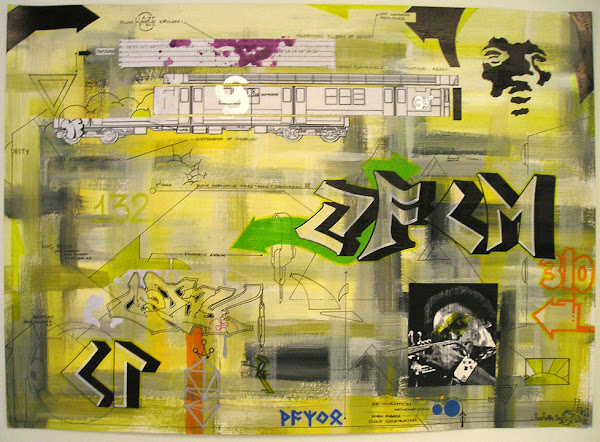
In the cauldron of New York in the late sixties a new form of art was born. Some considered it vandalism others considered it a symbol of urban blight - none dared to call it art save those who gave birth to it. We know this art form as Graffiti, a term that the artists themselves do not use. I call it Urban Street Art or, as my man K.R. ONE refers to it, "A highly stylized derivative of the alphabetical system, the enigmatic bending of what were once known as your ABC's."


Okay, I will concede that, to write on a subway car or the side of a building, without someone's permission, is an act of vandalism. However, graffiti moved from the street into the art gallery a long time ago. I knew this back in the mid eighties when I worked for Sotheby's Auction House in New York. Works by street artists like Jean-Michel Basquiat and Keith Haring started showing up in Sotheby's galleries and they were being sold, at that time, for tens of thousands of dollars. The same society, that vilified graffiti artists as vandals and criminals, was very eager to acquire their works on canvas to display in their condos on the upper east side. But this is often the case with art and artists. At Sotheby's we use to say that the profits from the sale of Impressionist paintings paid the rent and all of the salaries; Impressionist paintings being the most expensive in the market place. Yet we know that Van Gogh died virtually penniless after shooting himself in 1890. I also learned at Sotheby's that art appreciation has little to do with how much you like a work of art but how much that art will increase in value in the years to come.

Urban Street Art (U.S.A. dig!) had to be invented given the social climate at the time. There is always a symbiosis among the painter, the poet and the musician in any given generation. When jazz saxophonist Ornette Coleman released his album FREE JAZZ in 1961 whose painting graced the cover of the album? None other than Jackson Pollock, aka "Jack the Dripper", after all, you couldn't use a Rembrandt or a Caravaggio for the jacket of an album of free form improvisational music. Meanwhile on the other side of town , Baraka, Coltrane and DeKooning were creating a dithyramb of poetry, music and painting: an ars poetica for a new generation.


[On this page to the left is the cover of the album COLTRANE'S SOUND. To the right cover of Ornette Coleman's FREE JAZZ.]

The arrival of Urban Street Art was a continuation of an evolution that can be traced through the record cover art of the sixties and those glorious posters for concerts at the legendary Fillmore East & West.


[Top left & right we have the work of Abdul Mati Klarwein who designed the album covers for
Miles Davis' BITCHES BREW and for Santana's ABRAXAS. Bottom left is a poster for a concert at the Filmore featuring Jimi Hendrix and John Mayall.]

These urban neo-Miros and neo-Mondrians were troubadours of the transit system. Hell, they couldn't afford to buy and stretch canvases so they used what was available until they "got up and got noticed."


Even the late great Norman Mailer immortalized graffiti in his rare out of print book entitled, THE FAITH of GRAFFITI.


When I was at Sotheby's I worked on a video treatment of a collection of Impressionist paintings. The collection consisted of Lautrec, Monet, Pissaro, Renoir, Cezanne and Cassatt among others. The videotape depicted the beauty of the paintings magnificently with fades and dissolves that both accentuated and complimented the paintings. All that was needed was music. I tried Bach, Beethoven, Handel and Brahms and none of their music worked. When I spoke with a Hungarian film director named Karoly Bardosh, I asked him why was I having such a difficult time finding suitable music. He said I needed to use Impressionist composers whose music was more compatible with Impressionist paintings. He suggested using Claude Debussy, Erik Satie and Maurice Ravel. These are the composers who were doing in music what Monet and Mary Cassatt were doing on canvas. When I told Karoly how well the music complimented the paintings he said if I was looking for poetry in the same vein I should look at the work of Ezra Pound. Again the triumvirate of painting, music and poetry. So along with the arrival of this new Urban Street Art came Hip-Hop (rap) and break dancing. While pundits demeaned street artists in the press, Macy's and Bloomingdales were profiting from the sale of the urban street fashion that these artists inspired; from Harlem to haute couture. Like Punk Rock before, you know you've been co-opted when they start selling t-shirts held together with safety pins on Fifth Avenue, or when Rothko, Twombly and Motherwell, are sharing the stage with Basquiat, Haring and Fab Five Freddy.

Miles Runs the Hendrix Down

by

K.R. ONE


It's time to stop treating Urban Street Artists as criminals. By referring to this art as graffiti is to vilify both the art and the artist, while people, who know better, earn huge profits from its sale.

By the way, the creators behind this art movement do not call themselves graffiti artists, they simply refer to themselves as "writers."


I end this blog with a quote that I saw in a museum in Portland, Oregon some years ago:


"Art is the Holy Land wherein initiates seek
to reveal the spirituality of matter. As such
art can be counted as one of the supreme
sources of the triumph of the human spirit."


Have Pen, Will Write

JAKE